Short answer
Choose a flat sheet that leaves room for the message
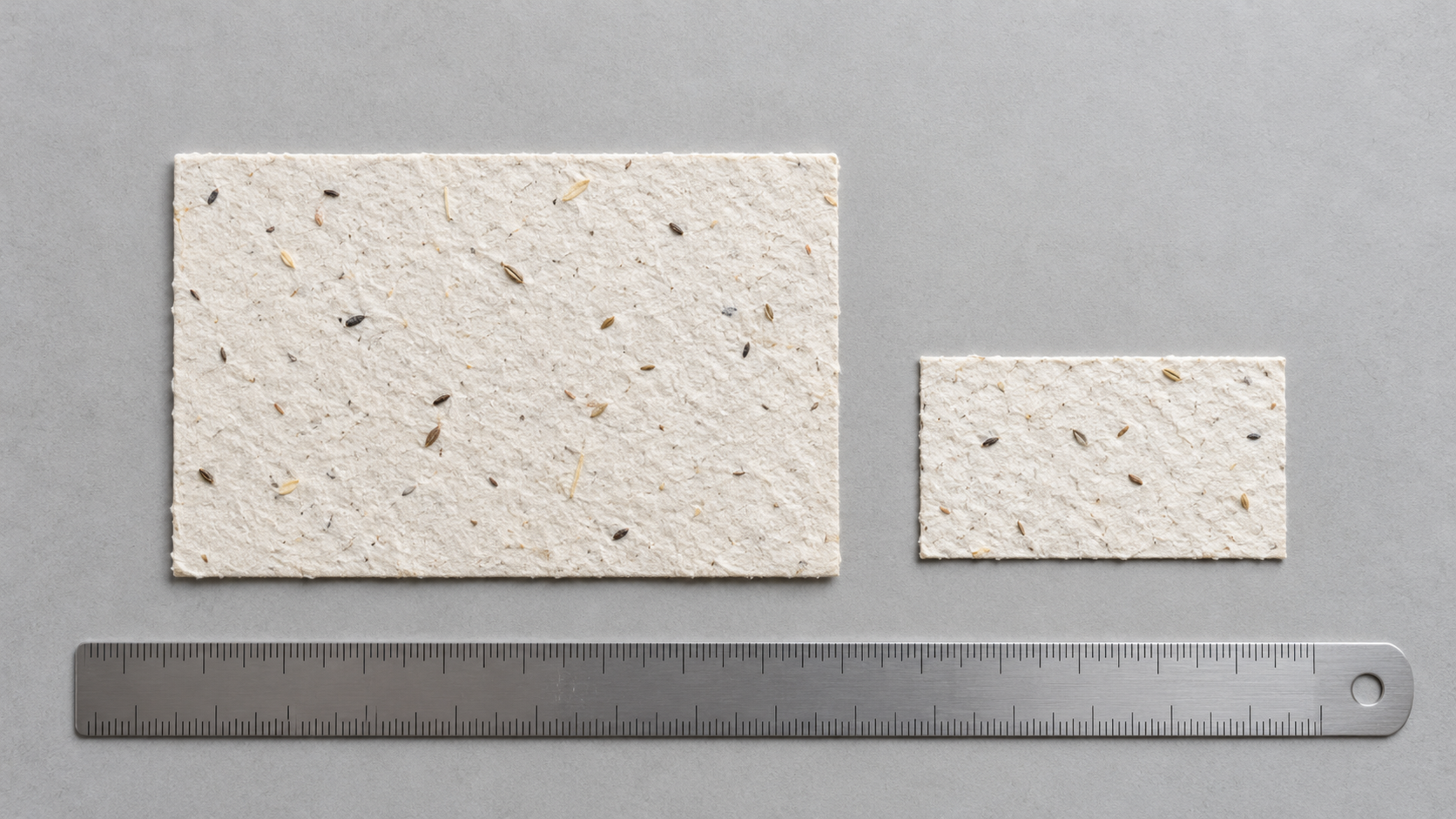
For a thank-you note, invitation, or gift insert with planting directions, 4 x 6 inches gives the layout more breathing room. A business-card-size piece can suit a short message and compact package, but its exact dimensions and readable print must be approved. Papyrn normally makes seed-paper cards flat: folding the sheet can crack it. We do not recommend reducing it to a very small format just to use less material.
Compare the two common formats
(about 102 x 152 mm)
A gift message, event invitation, or ecommerce insert that needs a clearer planting cue and more visual space.
Fit in the actual mailer or product box, artwork margins, and whether both sides need print.
A concise thank-you, small giveaway, or parcel insert with a short planting prompt.
Specify the exact cut size; leave enough space for legible text, brand details, and any QR code.
"Business-card size" is a format description, not a universal measurement. Tell the supplier your required finished width and height rather than assuming one country's standard. The supplier's 500 x 700 mm or 450 x 700 mm raw sheet dimensions are manufacturing inputs, not finished card sizes.
Why we normally keep seed-paper cards flat
Seed paper is a fibrous sheet with seeds embedded in it. In Papyrn's production experience, creasing it into a folded greeting-card shape can make the fold crack. That is why a single flat piece is our usual offer. If the campaign needs a card that opens, discuss a conventional folded paper card with a separate flat seed-paper insert; approve that construction as a new project rather than assuming the seed paper itself can be folded reliably.
Flat does not mean featureless. You can print a message on the front and a planting cue on the back, subject to artwork and sample approval. Our planting-copy guide explains what belongs in that cue.
Let readable content set the lower size limit
Decide what the recipient must actually see: the brand message, a verified seed name, a first planting step, and a link to longer instructions if needed. Small text on seed paper deserves particular care. Papyrn uses inkjet printing, and fibers, seeds, and ink spread can reduce the clarity you would expect from smooth offset-printed stock. Our artwork guide treats 12 pt as a provisional starting point for small type, not a guarantee that every font will print well. Read the physical sample at its finished size.
A QR code does not solve a crowded design automatically. Leave a clear quiet area, print it on the selected paper, and test scans on several phones. Keep a short human-readable URL or planting cue so the card still helps when a scan fails. If all this will not fit on the smaller card, move up to 4 x 6 inches or shorten the copy.
Check the package, not just the artwork
- Measure the usable space in the actual parcel, box, or envelope. Account for other inserts and the product, not only the outer box dimensions.
- Place a full-size paper mockup where the finished card will sit. Confirm it stays flat rather than being bent around the product or closure.
- Proof both sides on the selected seed paper. Check cut edges, readability, color, and any QR scan at the final size.
- Pack a sample the way the customer will receive it and check that the card is not crushed, curled, or hard to find.
For storage and shipment precautions, see our seed-paper handling guide. Shipping a plantable card to another country also needs a separate check for the actual embedded seed and destination.
How size affects the quote
Our current reference for 300 gsm seed-paper material is about RMB 160 per square meter, but that is a raw material-area reference, not a finished-card unit price or a rate for 200 or 500 gsm. A smaller card uses less paper area, yet the order price also reflects sheet layout and cutting waste, inkjet printing, seed selection, proofing, packing, and quantity. The same design in two sizes need not have prices in exact proportion to their areas. Papyrn seed-paper cards start at 100 pieces; request a finished-card quotation for each exact size and quantity under consideration.
What to send for a size recommendation
- The preferred format: flat 4 x 6 inches or exact business-card-size dimensions.
- The quantity, intended use, and destination country.
- A photo or measurements of the package where the card will be placed.
- Front and back artwork, planting copy, and any QR destination.
- The preferred seed-paper option and whether a physical sample is required.
Confirm the seed identity and planting claims separately from the size decision; a larger card does not make an unverified germination promise acceptable.
Published October 29, 2026; updated October 31, 2026 to clarify that the approximate RMB 160/m2 material reference applies only to 300 gsm seed paper. The 4 x 6 inch and business-card-size formats and fold-cracking observation reflect Papyrn's production guidance. Finished business-card dimensions, print legibility, and packing fit must be confirmed for each order. The image is illustrative.
FAQ
Size and construction questions
What sizes do you usually make for seed-paper cards?
Papyrn commonly makes flat 4 x 6 inch cards or business-card-size pieces. Confirm the exact finished dimensions of a business-card-size order before approving the artwork.
Can a seed-paper card be folded?
We normally recommend a single flat sheet. In our production experience, folding seed paper can crack the sheet, so a folded card should not be treated as the standard option.
Why not make the card as small as possible?
The card still needs room for a readable message and planting cue. Small inkjet-printed type or QR codes can be harder to read on fibrous seed paper; confirm the layout on a physical proof at final size.
Is a smaller seed-paper card proportionally cheaper?
Not necessarily. Material is priced by area, but a finished-card quote also depends on sheet yield, cutting waste, printing, quantity, seed option, and packing. Ask for a quote at the exact finished size.