Short answer
Print four things, after the seed is confirmed
Tell the recipient that the card is plantable, identify the verified seed, explain how to place and water the paper, and point to species-specific light and care guidance. Keep the brand message useful even if the card is never planted. Do not promise that every card will grow or that sprouts will appear on a fixed day.
What the supplier option sheet does and does not say
Papyrn's seed-paper reference sheet lists 20 named options with paper weight, sheet size, and reference germination temperature and time. For example, it lists luole (罗勒) at 20–35°C and 5–7 days, and taiyanghua (太阳花) at 20–25°C and 2–10 days. These are supplier-list references, not tests of a finished Papyrn card or promises about a customer's pot. The sheet's planting-method column mainly points to outside search results or articles; it is not a complete, approved instruction sheet for each seed lot.
A common-name label may be ambiguous. In particular, the sheet does not give a botanical name for taiyanghua, so do not silently print "sunflower" on the English card. Confirm the botanical identity and actual paper or seed lot before finalizing the plant name or any species-specific directions. Our seed-selection guide covers that approval step.
What a recipient needs on the card
- Plantable cue: Make it clear that the paper contains seeds and can be planted; do not make the recipient guess from a decorative graphic.
- Verified plant name: Use the English name approved for the actual seed, not an automatic translation of a supplier common name.
- First action: Tell the recipient to place the paper on prepared soil in a pot or suitable location and water it gently.
- Species-specific detail: Add the confirmed covering depth, light, and care advice for that seed. Do not copy one seed's directions onto another card.
- Expectation: Invite the recipient to keep the soil appropriately moist and follow the verified growing guidance, without guaranteeing a seedling count or date.
A seed-paper maker's planting example illustrates placing paper on soil, covering and watering it, but its exact covering depth and sprouting window belong to its paper and seed blend, not automatically to Papyrn's options. University of Minnesota Extension notes that sowing depth and light needs vary among seeds. That is why the final instructions must be matched to the confirmed species.
A short English template to approve for each seed
Front: A thank-you, invitation, or gift message that still works if the card is not planted.
Back, draft only: "This card contains [verified seed name]. Place the paper on prepared soil, [cover or leave exposed according to confirmed sowing guidance], and water gently. Keep the soil [confirmed moisture guidance] and place it in [confirmed light and temperature conditions]. Growing results vary. See [maintained URL] for full care instructions."
The bracketed fields are approval prompts, not copy to print. Have the supplier and buyer resolve them against the chosen paper and actual seed before artwork sign-off. If the verified details will not fit legibly, print a concise first step and a human-readable web address for the rest; do not rely on a QR code alone.
Three lines to leave off the card
A supplier time range is not a finished-card batch result or a customer-environment guarantee.
Give care steps and say results vary; publish a numerical claim only with relevant evidence.
Different seeds need different light, depth, moisture, and temperature.
Use directions approved for the confirmed species and destination.
The current sheet gives no botanical identity for that common-name label.
Confirm the species and English name before printing either one.
Our viability guide explains why a living-seed estimate, a germination test, and actual planting outcomes are different measures.
Proof the instructions on the real paper
Papyrn uses inkjet printing for seed-paper cards. Fibers, seeds, and ink spread can make small type or a QR code harder to read than on a smooth proof. Check the final English name, punctuation, smallest text, contrast, QR destination, and card size on a physical sample of the selected paper. Our inkjet artwork guide covers the print-specific checks.
If a QR code leads to longer planting instructions, the destination must stay available after delivery. It should identify the same seed and batch-relevant guidance as the printed card. Review any cross-border claims separately; being able to print a plant name does not establish permission to send that seed to every country.
Approval checklist before production
- Confirm the botanical identity and current availability of the seed paper for the order.
- Verify planting depth, light, moisture, and temperature guidance for that seed; do not treat the supplier time column as a promise.
- Have the buyer approve the English plant name and exact card copy.
- Print and read a physical proof at final size; test any QR code on several phones.
- Keep evidence for any numerical seed-performance claim, or omit the number.
Papyrn seed-paper cards start at 100 pieces. The quotation should include the finished size, quantity, seed option, destination, artwork, and any sample or evidence requirement.
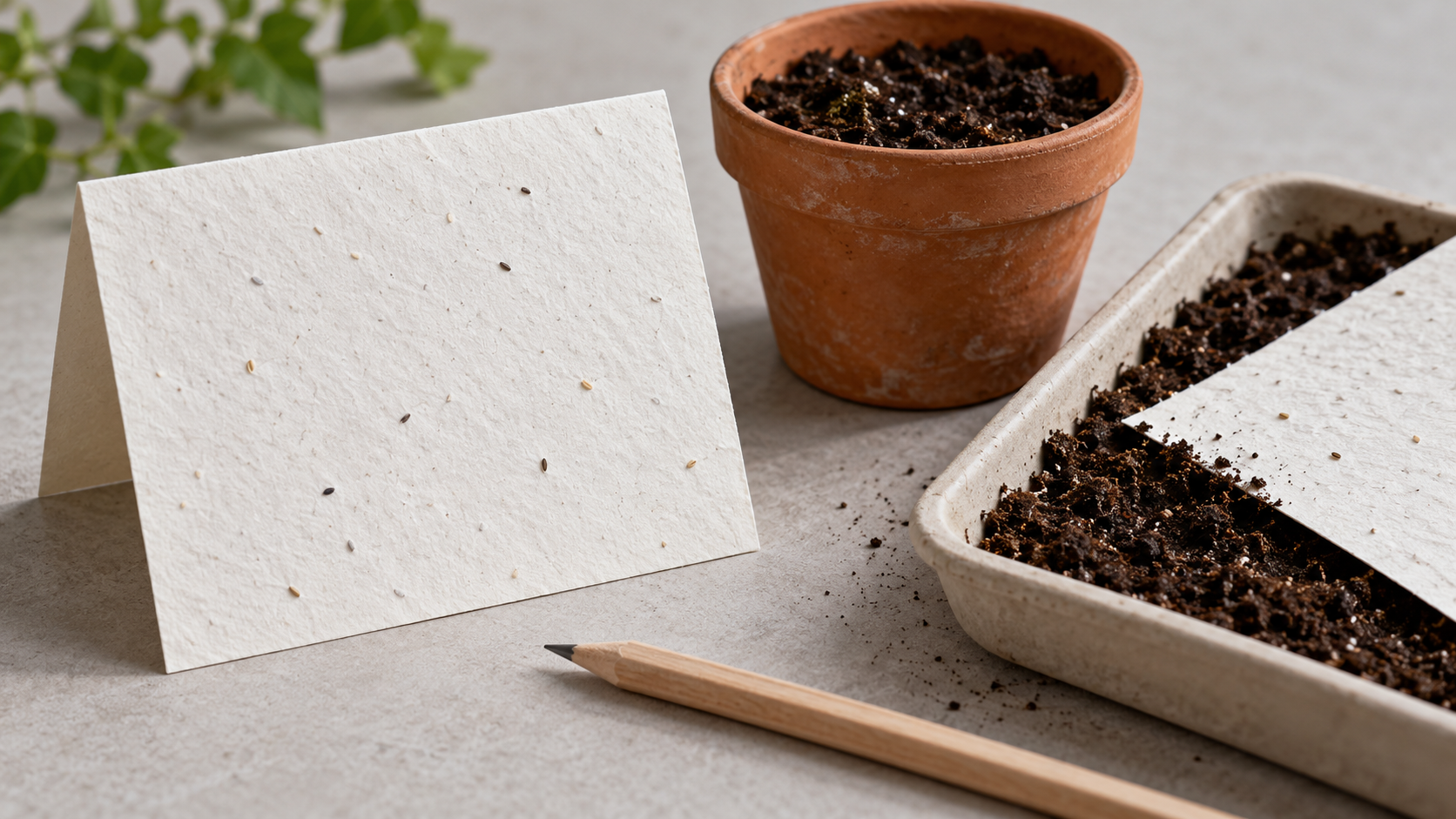
Published October 29, 2026. The supplier spreadsheet provides common names and reference germination conditions, not confirmed botanical identity for every option, current stock, finished-card batch results, or complete planting instructions. The sample wording above is a template requiring species-level approval. The image is illustrative.
FAQ
Planting copy decisions
Can one set of planting instructions work for every seed-paper card?
No. The short handling steps can share a format, but sowing depth, light, temperature, and timing depend on the confirmed seed. Approve the final instructions for the actual paper and seed lot.
Can I print a supplier's germination time on the card?
Treat a supplier-sheet range as a reference, not a delivery promise. Only use a species-specific range after confirming the seed identity and context, and avoid wording that guarantees a sprout by a fixed day.
Should I call the supplier's taiyanghua seed sunflower?
Not from the current sheet alone. Taiyanghua is a Chinese common-name label without a botanical name in that file. Confirm the actual species before translating it or writing species-specific directions.
Can a QR code replace instructions on the card?
A QR code can lead to longer, maintained instructions, but print a short readable planting cue and a human-readable destination as well. Test the code on the final inkjet-printed seed paper.