Short answer
Where does a plantable card fit?
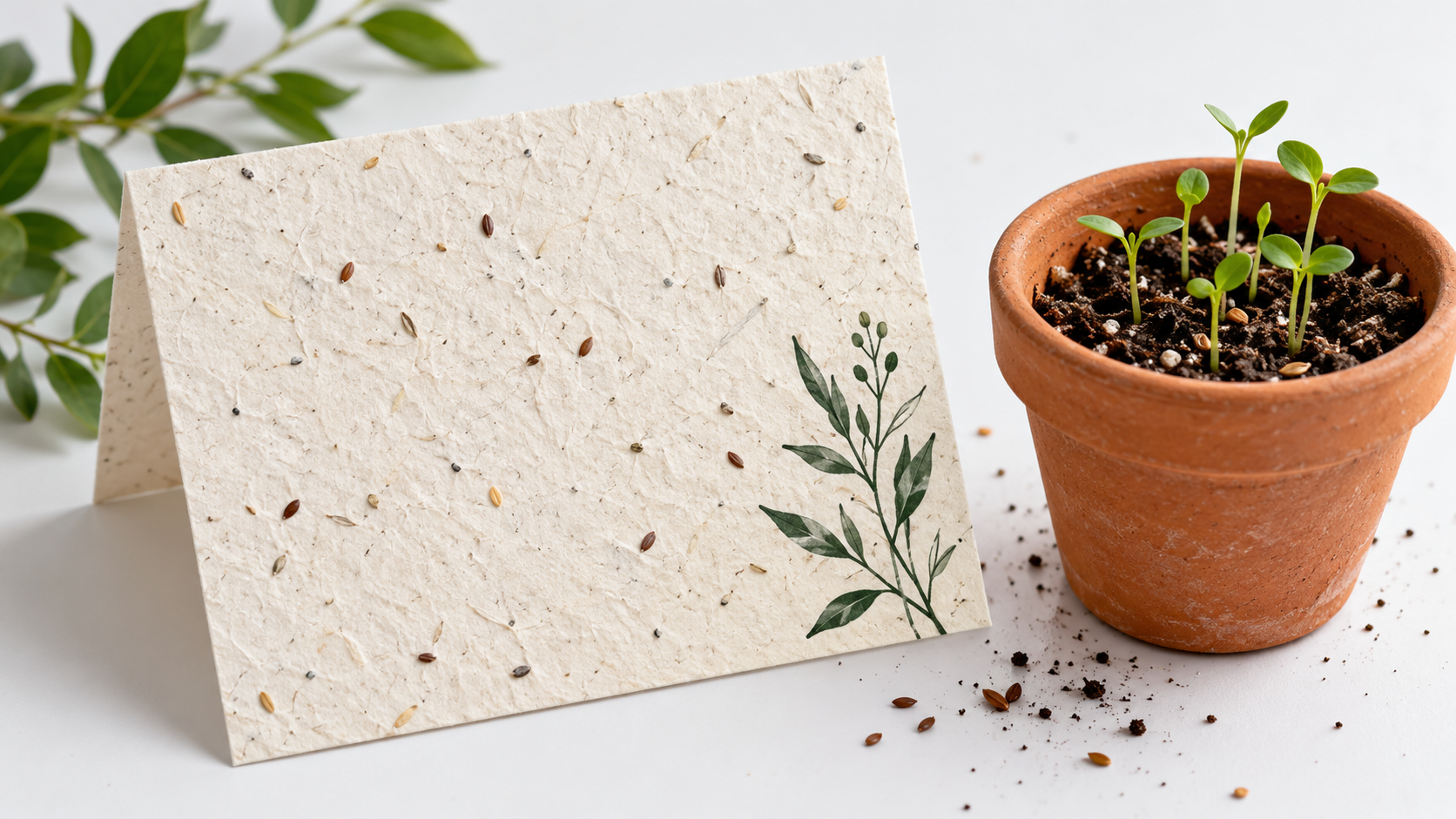
Use it when a short message deserves to be kept a little longer: an ecommerce thank-you, an event invitation, or a gift-set note. Papyrn's seed-paper cards start at 100 pieces and use inkjet printing. Keep planting directions on the card, choose the seed, and approve a printed sample before production.
1. Choose the occasion before the seed
The card should work even if its recipient never plants it. Decide what it needs to communicate, then decide whether the planting element adds value rather than distracting from the message.
Ecommerce thank-you cards
Place a brief thank-you inside an order where there is room for a separate insert. The front can carry the brand message; the reverse can explain how to plant the paper. Keep care instructions or order-critical details elsewhere if they must remain available after the card is planted.
Event invitations and take-home cards
For a launch, workshop, or customer event, a plantable invitation can become a take-home reminder. Make the date, venue, and response details easy to read first. If the event information must be retained, put it online or on a separate durable item as well.
Gift sets and seasonal campaigns
A small plantable greeting can accompany a gift box or limited campaign. Match the message and seed choice to the recipient and season, but do not imply that every recipient will have the same growing conditions. Test how the card sits alongside the products before fixing the card size.
Brand storytelling and promotions
Use a short card to explain why the brand chose a plantable insert or to invite customers to share their planting experience. Leave space for a concise call to action and simple planting steps. It is a message medium, not evidence of a broader environmental claim about the whole package.
Our supplier's paper list gives common-name options for flowers, herbs, and vegetables, but does not establish a scientific name for every entry. These are selection references, not a live stock count. Confirm the seed identity and available paper before naming a plant in customer artwork or quoting a specific design.
Placement checks for orders, gift sets, and events
Inside an ecommerce parcel
Put the card where it will be noticed as the parcel opens, before the product is lifted out. Keep the thank-you short and put planting directions on the reverse. Do not cover a required product label or use the card in place of protective packing. If the insert only repeats a website address, a conventional card may serve the order better. For a broader message checklist, see our product insert card guide.
Within a gift set
Check the card against the complete packed layout, not just an empty box. A greeting card can sit above the products, but it should not hide the contents, bend against the lid, or shift during handling. Photograph the full set with the card in place, then close and reopen a physical sample. The card is presentation material, not a structural insert or cushioning layer.
After a workshop or event
Use a take-home card for a brief follow-up message and one clear next step. Put time-sensitive event details on a website or a separate durable item because the recipient may plant the card. Keep the contact route readable even when a QR code is included.
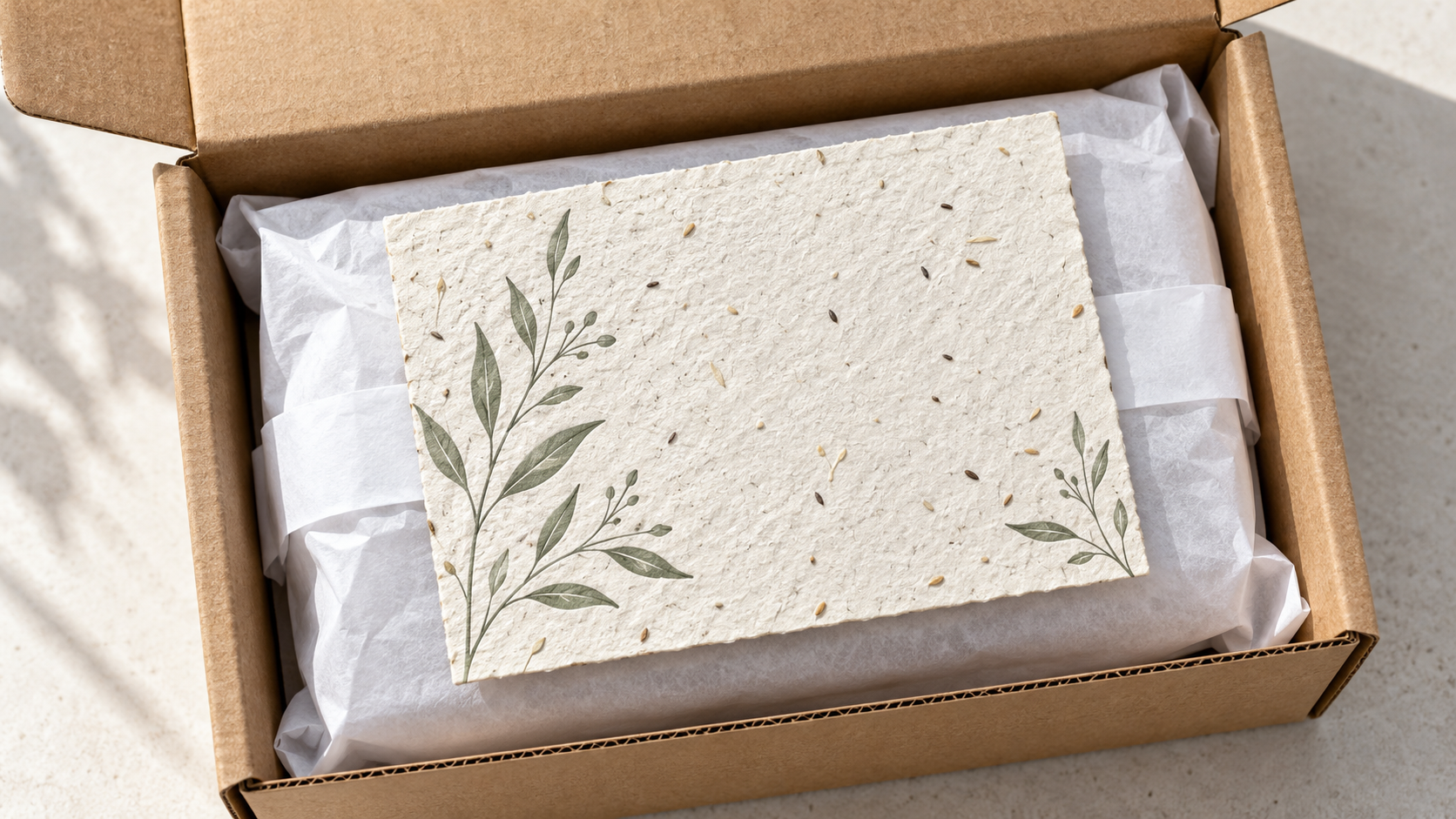
Illustrative packaging scene, not a Papyrn production sample. Check the real packed box before approving placement.
2. Design for seed paper and inkjet printing
Seed-bearing sheets can have more texture and variation than a conventional smooth card. Papyrn uses inkjet printing for this service. Before production, test legibility of small text, color, ink coverage, and the finished card size on the actual paper. Keep planting instructions readable; test a QR code after printing rather than trusting digital artwork alone.
Send one print-ready design and specify whether every card carries the same message. Paper weight, color, seed type, and finishing must be confirmed against the selected stock. Do not copy a normal coated-card specification onto plantable paper without a sample check. A specialist seed-paper producer likewise recommends test printing because sheets vary in thickness and surface texture. See its printing guidance.
3. Separate seed viability from a promise to germinate
Our working reference is that roughly 90% of individual seeds may remain viable after cardmaking. This is an estimate supplied for planning, not a published Papyrn batch test, an independently certified figure, or a guaranteed result for an order. Check the test method and lot record before placing a numeric claim on the card.
For example, a card with ten embedded seeds does not promise nine sprouts. Viability describes living seed potential; a germination test assesses emergence under defined conditions. Actual growth also depends on species, storage, moisture, temperature, and how the card is planted. Iowa State's seed laboratory explains why viability and germination measurements can differ.
Provide planting directions for the selected species rather than one fixed temperature or number of days for every card. The supplier list includes reference growing temperatures and times, but these are not batch-specific promises. Keep finished cards cool and dry before use; seed quality can deteriorate with heat and moisture. Colorado State Extension explains the storage factors.
When a conventional card is the better fit
Choose a standard card when the design needs a perfectly smooth print surface, dense small text, heavy ink coverage without texture, or a waterproof finish. Seed paper is also the wrong place for information that must be kept after planting. Neither an attractive card nor several embedded seeds can guarantee sprouts, so do not make germination the only value of the message.
What to send for a useful quote
- Card use case, finished size, artwork, and order quantity (at least 100 pieces).
- Preferred seed-paper option and any color or paper-weight preference.
- Whether the card is flat or folded, and where the planting directions will go.
- Whether a printed sample or a lot-specific seed test is required.
- Any QR code or small text that needs legibility testing.
A printed sample checks appearance; it does not replace seed-lot evidence or guarantee how the card will grow in a customer's environment.
Published October 24, 2026; updated October 28, 2026. Seed options and growing times are supplier-list references, not current inventory or guaranteed results. The approximately 90% viability figure is an unverified working estimate, not a batch certificate. Confirm the final seed and sample for each order.
FAQ
Seed-paper card ordering
What is the minimum order for Papyrn seed-paper cards?
Custom seed-paper cards start at 100 pieces. Confirm the finished size, seed-paper choice, artwork, and available seed type before requesting a final quote.
How are the cards printed?
Papyrn uses inkjet printing for these cards. Print quality and artwork coverage should be checked on a physical sample of the selected paper.
Does 90% seed viability mean 90% of cards will sprout?
No. Around 90% is a working estimate of seed viability after cardmaking, not a batch-certified result or a germination guarantee. A card can contain several seeds, but actual emergence depends on the seed lot, storage, planting, moisture, temperature, and other conditions.
When is seed paper a poor choice for a card?
Use a conventional card when the design requires a perfectly smooth surface, very small text, a waterproof finish, or a guaranteed planting outcome. Test the actual seed paper before committing to a demanding print design.
Where should a seed-paper thank-you card sit in an order?
Put it where the customer can see it during unboxing, without covering a required product label or replacing protective packing. Check the complete packed box and lid closure with a physical sample.