Short answer
What size should you send for a custom mailer box?
Send the maximum dimensions of the complete product set, photos of how the items will sit in the box, and any cards, bands, or inserts packed with them. Ask the supplier to propose the finished inside box dimensions. Then test the actual products in a physical box sample with the lid and both side tucks fully closed. The outside size does not describe the usable space inside.
Inside dimensions are a starting point, not a closure test
Length, width, and height on a quote describe the finished box. A mailer box also has folding panels and locking sections. When its lid closes, the left and right side sections tuck into the box. These sections take up some of the space that appears free when the box is open. The usable space around the contents therefore depends on the actual structure and how the products are arranged.
Do not apply one fixed clearance to every product. Check the finished dieline and a physical sample, especially if the box is tightly sized. Our unfolded-size guide covers how the chosen finished size also affects production cost; this article focuses on whether the pack can actually close.
Case 1: a spiral-bound notebook
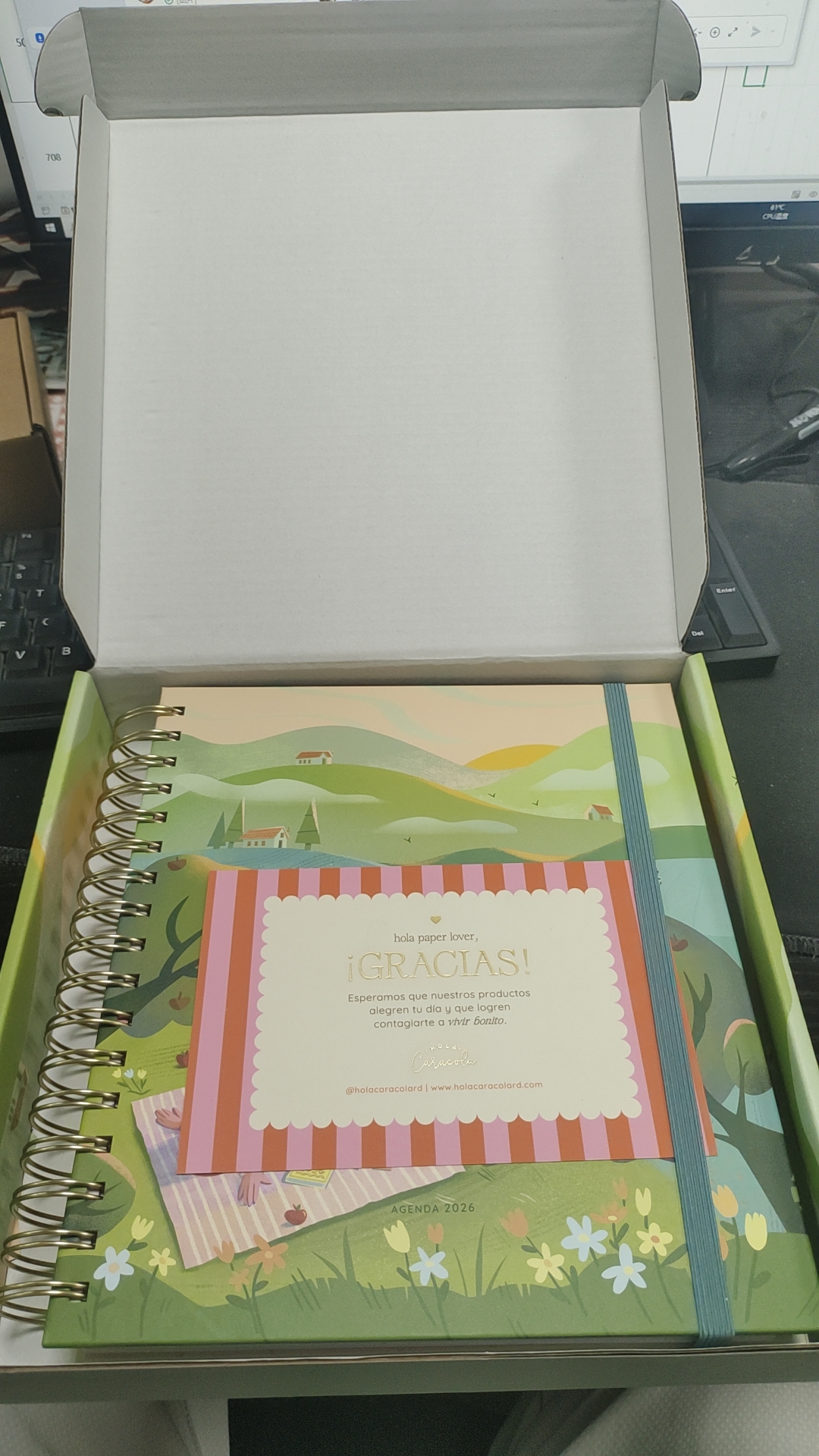
The notebook in this project was listed at 21.7 × 22.9 × 3.5 cm. The mailer box measured 22.8 × 23.8 × 3.9 cm inside and 24 × 24 × 4.2 cm outside. Its specified construction was 300 gsm white board with E-flute 4W.
The first risk was the spiral binding, shown in the real packing photo above. Measuring only the flat cover thickness can miss the binding's highest point. Confirm the notebook's true maximum height at the coil before comparing it with the box's inside height; the listed 3.5 cm should not be assumed to include the coil without checking the physical item.
The second risk was closure. The two lid-side tucks must enter the box beside the notebook. The difference between the notebook and box dimensions is a total nominal difference, not a guaranteed allowance on each side. Place the notebook and anything packed with it in the sample, close both tucks without force, and check whether the coil or cover is pressed by the lid.
Case 2: a multi-item painting set
For a painting set containing several pieces, the longest component measured 28.2 cm, and the proposed box had an inside length of 29.2 cm. The arranged set measured 20.2 cm across, with a proposed inside width of 20.7 cm. The box specification was 250 gsm white board with E-flute 4W.
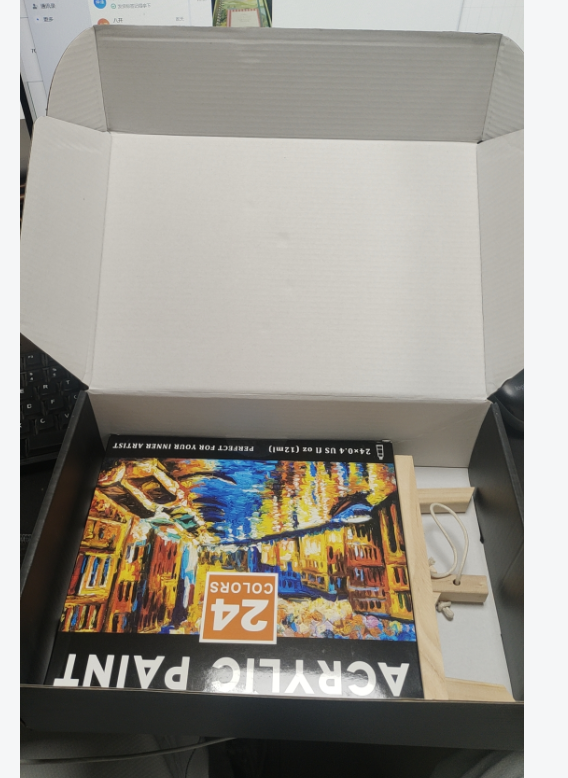
The easily missed point was not the number of items but the box's own side sections. They fold down and occupy space beside the arranged products as the lid closes. The 20.7 cm stated inside width should not be read as 20.7 cm of unobstructed product space during closure. The 0.5 cm difference from the arranged width describes this project, not a clearance rule for other mailers.
Arrange every item as it will be packed, then close the physical box with both side tucks in place. If either tuck needs to be forced past a product, revisit the arrangement or the box structure and size. Recheck the fit whenever the contents or their positions change.
A practical approval sequence
- Measure the complete products at their widest and highest points, including bindings and attached parts.
- Photograph the intended arrangement with any cards, bands, wraps, or inserts.
- Ask for the proposed inside dimensions and box construction, not only the outside dimensions.
- Put the real contents into a physical sample; close the lid and both side tucks without force.
- Reopen the box and check for pressure marks, shifting, or a lid that springs open.
If the sample does not close cleanly, change the layout, inside size, or structure before approving production. See the sample-types guide for choosing a fit-check sample.
Published October 23, 2026. The two sets of dimensions are individual Papyrn project examples, not universal sizing formulas, production tolerances, or guarantees of fit. Verify actual maximum product dimensions, dieline, board, arrangement, and closure with the finished sample.
FAQ
Mailer-box fit questions
Should I give the supplier my product size or the box's outside size?
Start with the maximum dimensions of the complete product set and describe how it will be packed. The supplier can then propose finished inside box dimensions. Outside dimensions are not the available space for the product.
How should I measure a spiral-bound notebook?
Measure its maximum length, width, and height, including the highest point of the spiral binding. A thickness measured only across the flat cover may understate the space needed for closure.
Why can a product fit in an open mailer but prevent it from closing?
The lid's side sections fold down into the box beside the contents. They use some of the space that appears available while the box is open. Check both side tucks with the complete product set in a physical sample.
Can I add the same clearance to every mailer box?
No. The required room depends on the particular dieline, side-tuck geometry, board, product shape, and arrangement. The dimensions in these case studies are project examples, not a universal allowance.