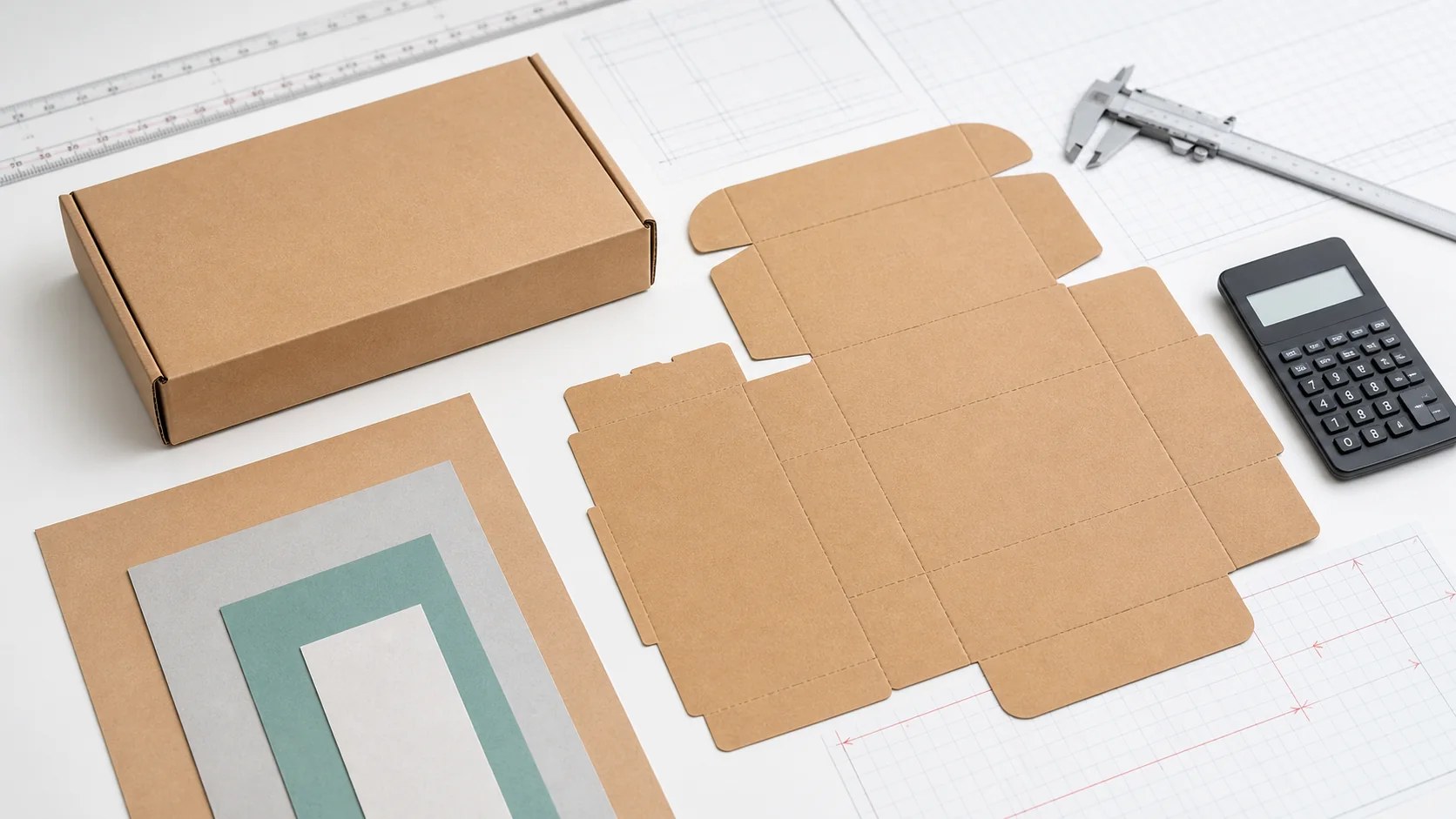
Short answer
Why can 1 cm change the custom mailer box price?
A custom mailer box is not priced only by its finished length, width, and height. The factory calculates the unfolded production size first, then checks whether that size fits an eighth sheet, quarter sheet, half sheet, full sheet, or above-full sheet. When a small size change pushes the unfolded size into the next class, fixed printing and die-cut fees can increase, and that jump is obvious in low-MOQ orders.
Unfolded size calculator
Check the sheet class before asking for a custom mailer box quote
Enter the finished inside size in centimeters. This calculator uses Papyrn's current mailer box pricing rule: base unfolded size plus extra allowance for production and sheet classification.
Formula: 2W + 3H by L + 4H + 2 cm margin.
Includes +2 cm length and +4 cm width production allowance.
Fits 700 x 500 mm. Pricing area: 0.240 sqm.
Estimated setup allocation based on the current sheet class and 200 pcs.
In this calculator, L, W, and H refer to the finished inside box size in centimeters. This is a planning calculator, not a final quote. The fixed setup allocation above is a planning reference for the selected sheet class and quantity. It excludes paper, printing coverage, lamination, mounting, knife plate, packing, freight, tax, artwork, and final factory workload.
Papyrn packaging team experience
In small-batch mailer box projects, buyers often compare two box sizes that look almost the same from the outside. The quote can still change because the larger size may cross a sheet boundary after unfolding and production allowance.
For example, if a brand increases height to make the unboxing feel more premium, that height appears multiple times in the unfolded formula. A small finished-size change can create a larger unfolded jump than the buyer expects. Papyrn usually checks unfolded size, sheet class, freight volume, and locking structure before suggesting a final box size.
1. Finished size and unfolded size are different
The finished size is what the buyer sees: length x width x height of the assembled mailer box. The unfolded size is the flat production layout before die-cutting and folding. Pricing needs the unfolded size because printing, lamination, mounting, and die-cutting are all related to the flat sheet.
In this guide and calculator, L, W, and H refer to the finished inside box size in centimeters. Outer size, paper thickness, and special structure may need manual checking before final quotation.
For Papyrn's current mailer box pricing rule, the base unfolded size is calculated as:
Base unfolded length = 2 x W + 3 x H
Base unfolded width = L + 4 x H + 2 cm margin
Pricing unfolded size = base size + 2 cm length and + 4 cm width
This means height has a strong effect. If the height increases by 1 cm, it can add several centimeters to the flat layout, not only 1 cm.
2. Visual guide: from finished box to sheet class
These simplified diagrams show why buyers should not compare only the assembled box size. The factory needs to check the flat layout and whether it crosses a sheet boundary.
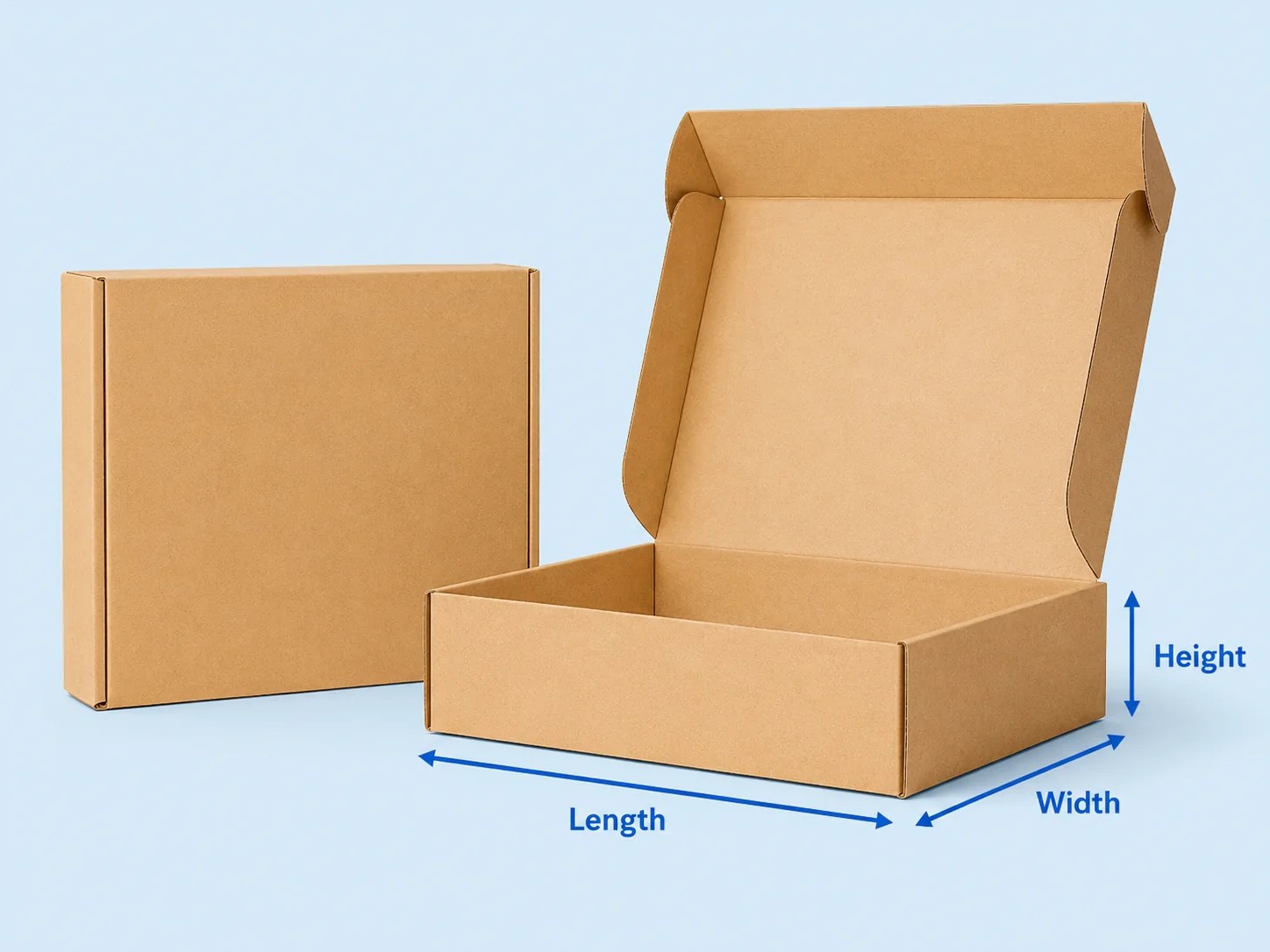
Folded mailer box: finished inside L x W x H
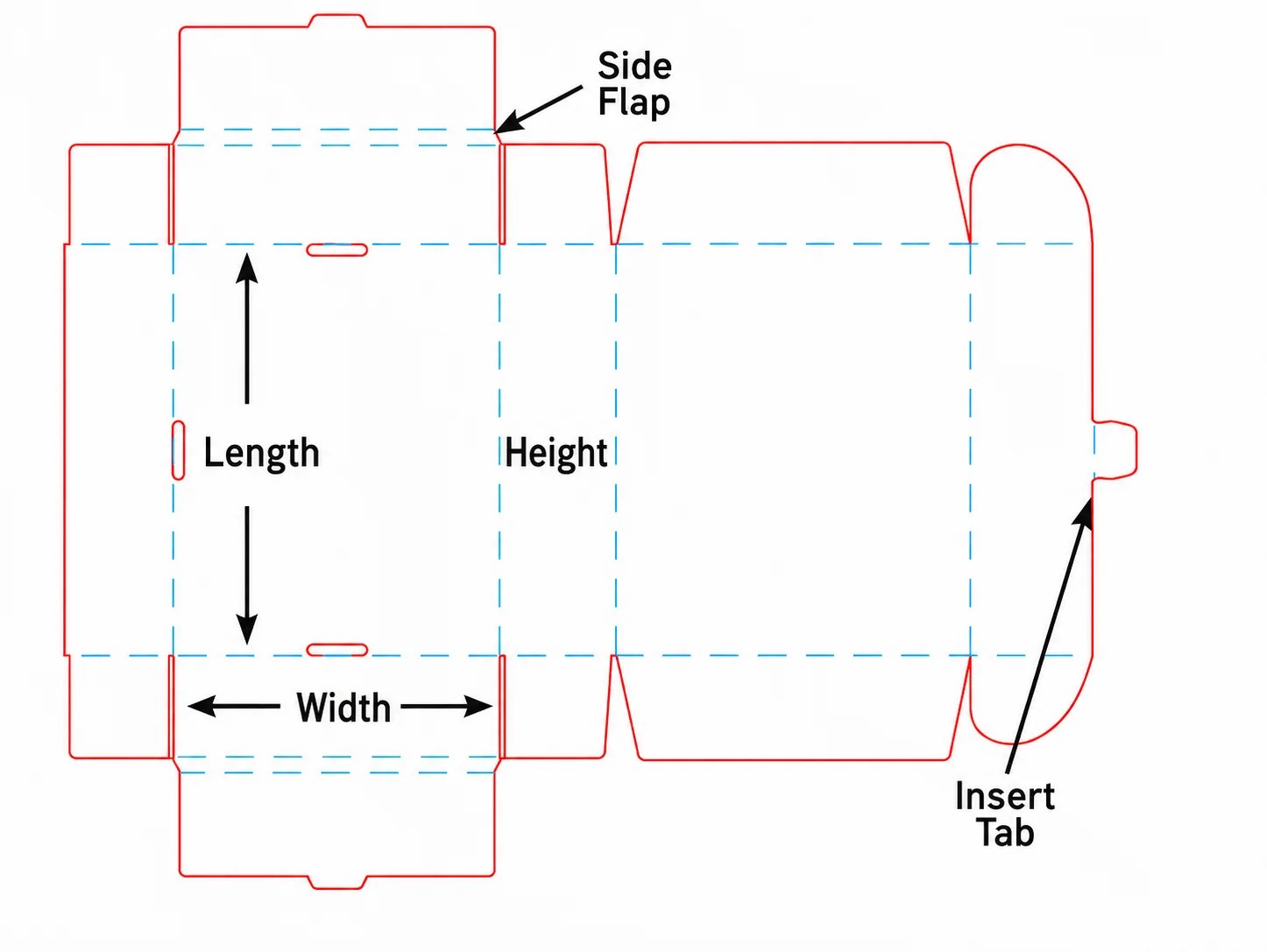
Unfolded layout: finished L/W/H create the flat pricing size
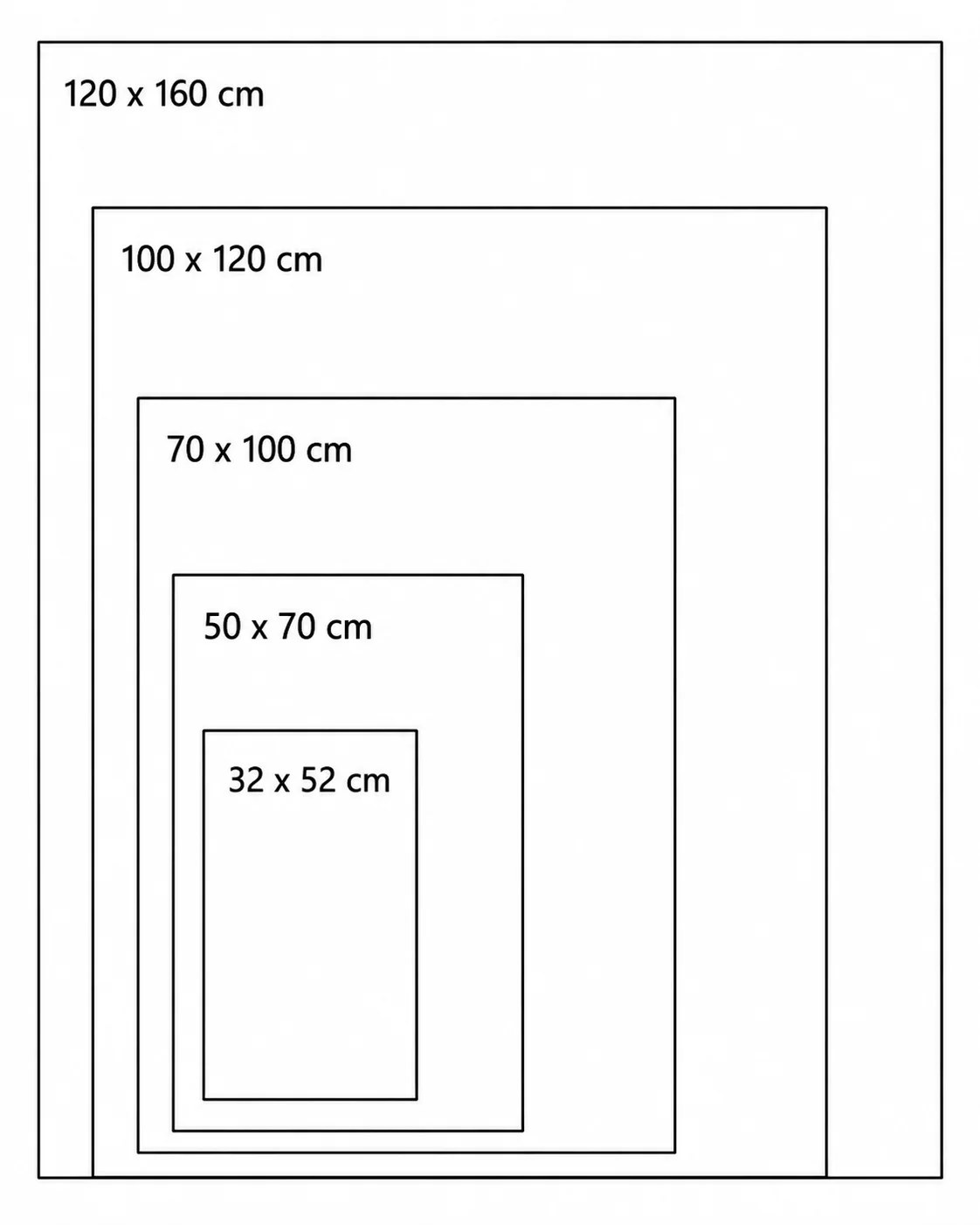
Larger sheet classes carry higher fixed setup costs
3. Four lessons for low-MOQ mailer box sizing
Finished size is not the size used for sheet classification
A mailer box is priced by its unfolded production size, not only by the finished length, width, and height. Height has a strong effect because it appears several times in the unfolded formula.
A 1 cm change can push the box into the next sheet class
If the unfolded size is close to a sheet boundary, a small change in length, width, or height can move the box from eighth sheet to quarter sheet, or from quarter sheet to half sheet.
Small quantities feel the fixed-fee jump most clearly
Printing setup and die-cut fixed fees are divided by the order quantity. At 200 pcs, a higher sheet class can noticeably increase the unit price even before material and freight are added.
A right-sized box protects both budget and shipping cost
Oversized mailer boxes increase unfolded area, paper use, fixed-fee class, carton volume, and international freight. For small brands, structure and size should be checked before decoration.
4. Sheet class controls fixed fee levels
After the unfolded size is converted to millimeters, the factory checks the smallest sheet class that can fit the layout. Rotation is allowed when checking fit. The class affects fixed printing setup and die-cut setup fees.
The fixed setup figures below are Papyrn's current planning reference for this calculator. They are not fixed public prices and may change with material, process, workload, artwork, and production arrangement.
320 x 520 mm
Planning fixed setup: US$42.00
700 x 500 mm
Planning fixed setup: US$70.00
700 x 1000 mm
Planning fixed setup: US$100.00
1000 x 1200 mm
Planning fixed setup: US$180.00
1200 x 1600 mm
Planning fixed setup: US$300.00
The exact quotation still needs material, printing, lamination, mounting, knife plate, packing, freight, and tax checks. But the sheet class explains why a small size change can create a large price change in low quantities.
5. Why the jump is stronger at 200 pcs than at 2,000 pcs
In low-MOQ orders, fixed fees are divided by fewer boxes. If a sheet class change increases fixed printing and die-cut setup fees, the per-piece allocation can be obvious at 200 pcs. At 2,000 pcs, the same fixed fee is spread across many more boxes, so the unit impact is smaller.
This is why Papyrn does not recommend choosing a custom mailer box only by appearance. For small brands, a slightly smaller or more efficient structure can keep the project within a better sheet class and reduce both production cost and freight pressure.
6. Production details that should be confirmed before bulk
Sheet class is only one part of mailer box pricing. Production risk also matters. A low-cost box is not useful if the lock position, crease line, corrugated direction, or packing method is unclear.
Confirm the dieline, tuck/lock position, and finished folding effect before bulk production. The box should close properly, not pop open or feel loose.
For laminated corrugated mailer boxes, face paper, corrugated board, front/back direction, and mounting direction need to be clear before production.
Thicker or rough corrugated material can crack at crease lines if pressure is not suitable. First-piece folding should be checked during die-cutting.
After printing and lamination, check for bubbles, scratches, wrinkles, and severe paper curl before die-cutting and packing.
Packing quantity, carton marks, carton weight, Amazon/3PL requirements, and door-to-door delivery needs should be confirmed before shipping.
7. What buyers should send for a sheet-class check
To check whether a custom mailer box is likely to stay in a better sheet class, send the product size, product weight, preferred inside box size, quantity, printing side, material preference, artwork files, destination, and delivery route. If you are unsure about box size, send product photos and product dimensions first.
For Amazon warehouse, 3PL, or door-to-door delivery, carton packing and label requirements should be confirmed early. A box size that is efficient for production may still need adjustment for shipment rules or carton packing. Buyers should follow the latest Seller Central, 3PL, and specific warehouse requirements before shipment.
8. Freight size references
If your box is close to a sheet boundary, also check carton volume and dimensional weight. Production size and shipping size can both affect the final landed cost.
Reviewed by Papyrn packaging team. Updated July 23, 2026. This guide explains Papyrn's current planning logic for custom mailer box unfolded size and sheet class. It is not a final quotation.
FAQ
Mailer box unfolded size and sheet class questions
Why can a custom mailer box become more expensive when the size only changes by 1 cm?
A 1 cm finished-size change can increase the unfolded production size. If the new unfolded size crosses a sheet-class boundary, printing and die-cut fixed fees may jump to the next class, which is especially noticeable for small quantities.
How is a mailer box unfolded size calculated?
For Papyrn's current mailer box pricing rule, base unfolded length is 2W + 3H, and base unfolded width is L + 4H + 2 cm margin. For pricing classification, 2 cm is added to unfolded length and 4 cm is added to unfolded width.
What sheet classes are used for mailer box pricing?
The current classification uses eighth sheet 320 x 520 mm, quarter sheet 700 x 500 mm, half sheet 700 x 1000 mm, full sheet 1000 x 1200 mm, and above-full sheet 1200 x 1600 mm, with rotation allowed when checking fit.
Why do fixed printing and die-cut fees matter more for low MOQ orders?
Fixed setup fees are divided by the number of boxes. At 200 pcs, a fixed-fee increase has much more impact per piece than it would at 2,000 or 5,000 pcs.
Is the calculator a final quote?
No. The calculator is a planning tool for unfolded size and sheet class. Final quotation also depends on material, printing, lamination, mounting, knife plate, packing, freight, tax, artwork, and production workload.