Short answer
Which flute should you ask about first?
For Papyrn's color-printed mailer boxes, E-flute is normally the starting point. With a face paper mounted on each side of the corrugated board, the complete construction can already have substantial stiffness for many suitable products. B-flute is more often considered for very large cartons or simple one-color logo printing. Some color-printed E-flute projects can start at 200 boxes; around 300 is another practical starting quantity. Our typical B-flute planning MOQ is around 2,000. All three figures need project-specific confirmation.
E-flute and B-flute in Papyrn's usual production plan
E-flute is normally preferred in our production setup. Full-color B-flute is not the usual default. Confirm the print surface, board construction, and sample before ordering.
B-flute may be considered, especially for larger cartons or a simpler logo-print job. The right structure still depends on dimensions and the packed product.
Some E-flute color-print jobs can start at 200 pieces; approximately 300 is another workable planning level. B-flute projects commonly plan around 2,000 pieces. These are not blanket guarantees.
For either flute, review a physical box with the actual product and inserts. Check closure, panel stiffness, fit, print, and packing method.
The flute name identifies only one part of the corrugated construction. Board grade, face paper, mounting, structure, size, and packing conditions all influence the final result. See our custom mailer-box page for the broader product options.
Why full-color mailers commonly use E-flute
Many buyers assume that choosing a larger flute will automatically create a better printed box. That overlooks the whole construction. For many of our color-printed mailers, an E-flute board with face papers mounted on both sides already provides useful rigidity. This is why we generally do not switch to B-flute merely because the box will be printed in color.
The artwork and print substrate still matter. Printing on white card and printing on brown kraft lead to different color results and finishing decisions. A white-card print in our usual construction generally needs film lamination to help protect folds; brown kraft normally does not, but it can affect light ink colors. These are print-surface decisions, separate from choosing E- or B-flute. Our unprinted versus printed mailer guide explains those choices.
When B-flute deserves a separate quote
For a very large carton, or a job with just a one-color logo, B-flute can be worth reviewing. It is not a universal upgrade and it should not be specified without the finished dimensions, product, handling route, and print requirement. A large box may also need a different structure rather than only a different board. Compare a mailer with a suitable shipping-carton option before committing to tooling.
At the order quantities Papyrn normally sees, B-flute also has a much higher planning MOQ: around 2,000 pieces. That may be sensible for a repeat large-volume order, but it can be impractical for a small brand testing a new size or design. The large-product box-structure guide explains why a shipping carton may be a better comparison than a scaled-up mailer.
How to read the 200, 300, and 2,000-piece quantities
200 pieces is possible for some color-printed E-flute mailer projects. About 300 pieces is another flexible starting point for E-flute. Neither means every artwork, dimension, face paper, and finishing combination can be produced at that quantity. About 2,000 pieces is the usual B-flute planning minimum in our setup, not an exact threshold for every possible order.
When requesting a quote, ask for the actual minimum for your specific size and design, then request price breaks at the quantities you could realistically use. A low unit price at a quantity you cannot store or sell is not necessarily a better purchase. Compare production, sampling, packing, freight, and destination terms at the same time. For timing and quantity questions, see the MOQ and lead-time guide.
Do not choose by a strength claim alone
Neither flute letter gives a complete load rating. A different face paper, box style, dimension, closure, or product arrangement can change how a finished pack behaves. Two mounted face papers can make an E-flute construction suitably stiff for many applications, but that does not promise it will protect every product or survive every delivery route.
Place the actual product and inserts in a physical sample. Check how the walls and lid behave when closed, whether the contents move, and whether the shipping label or outer carton changes the packing plan. If the product is heavy, fragile, or unusually large, ask the supplier to review that use case rather than selecting board from a comparison chart alone. A structural sample can test fit before print approval.
Send one clear brief for a comparable quote
Share the finished inside length, width, and height; product dimensions and weight; quantity per size and artwork; print coverage and number of colors; white-card or brown-kraft preference; desired finish; packing method; delivery destination; and target date. State whether you need a colorful branded mailer or a large transport carton with only a logo. Ask for the proposed flute, face papers, board construction, MOQ, and sample type in the response.
If both E- and B-flute are being quoted, keep the finished size, contents, artwork goal, and delivery terms consistent. Otherwise the difference in price or performance may come from more than the flute. The paper-box quote checklist provides a fuller brief.
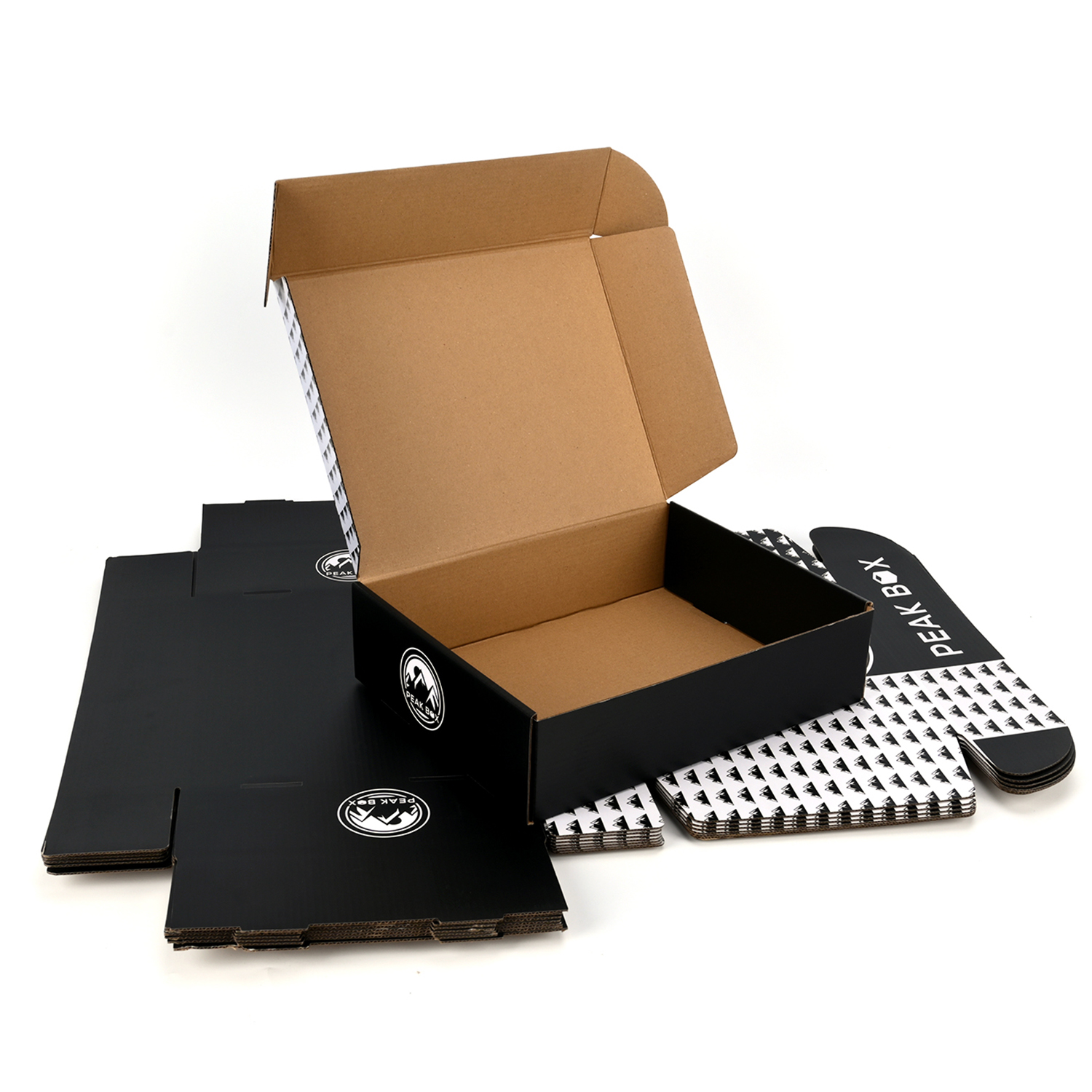
Published October 14, 2026. These are Papyrn production-planning references, not fixed specifications, load ratings, universal MOQs, or binding quotations. Confirm board construction, quantity, artwork, sample, and delivery terms for the actual order. The photograph shows a mailer box but does not identify its flute.
FAQ
E-flute and B-flute buying questions
Is E-flute the usual choice for full-color mailer boxes?
In Papyrn's usual production plan, yes. Most color-printed mailer boxes use E-flute. The proposed board, mounted face papers, size, and product fit still need to be checked for each order.
When would Papyrn suggest B-flute?
B-flute is more commonly considered for very large cartons or a simple one-color logo job. It is not the usual starting point for Papyrn's full-color printed mailers. Final suitability depends on the box size, product, and packing route.
Can I order 200 full-color E-flute boxes?
Some color-printed E-flute mailer-box projects can start at 200 pieces. Around 300 pieces is another practical planning quantity. Neither number is a universal minimum; confirm size, artwork, board, printing, and current production setup for your design.
What is the usual B-flute minimum order?
For Papyrn's typical B-flute projects, plan around 2,000 pieces. Treat this as a planning reference, not a guaranteed minimum for every size or construction.
Is B-flute automatically stronger than E-flute?
Do not choose by flute letter alone. The full board construction, face papers, box dimensions, packed product, and handling conditions all matter. Ask for the proposed specification and test a physical box with the actual product.
Does mounting two face papers mean the box is film laminated?
No. Mounting face papers to corrugated board describes the board construction. Film lamination is a separate print-surface finish. Ask the supplier to identify both in the quote.