Short answer
Which print plan should a small brand start with?
Unprinted mailer boxes are usually natural brown kraft. For printed boxes, first decide whether the design belongs on white card or brown kraft, then choose outside-only or inside-and-outside coverage. White-card printing in our usual construction generally needs lamination to help prevent cracking at folds. Brown kraft does not generally require lamination, but its color can alter light artwork; a white-ink underprint is possible at extra cost. Compare identical size, board, quantity, packing, and delivery terms.
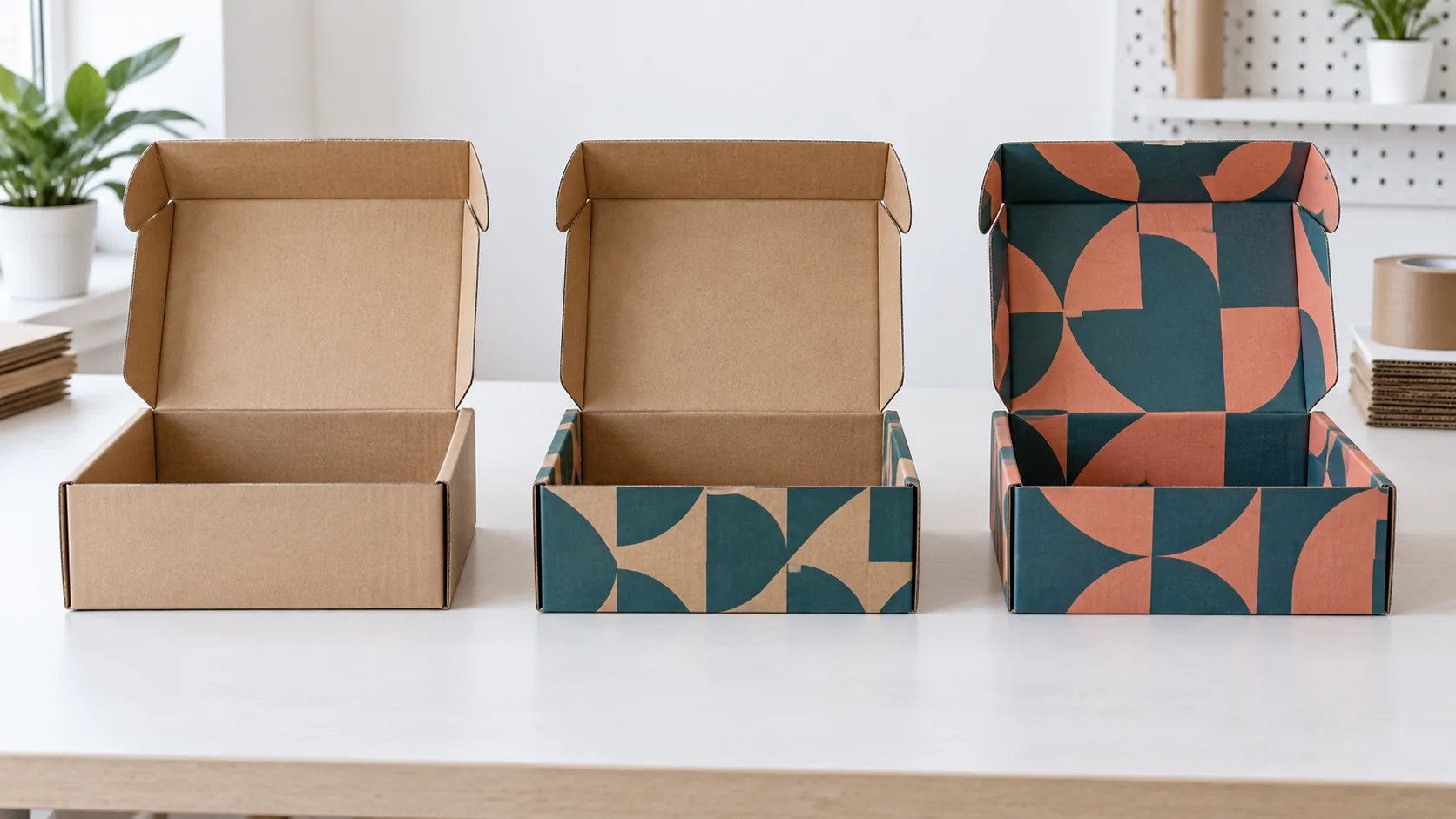
Compare the same mailer box in three print plans
Usually natural brown kraft inside and out. Black unprinted boxes made with black cardstock are possible but uncommon. Suitable for a restrained look or a pack built around tissue and cards. Custom die-cutting, board choice, and freight still affect cost.
Artwork is visible during delivery while the inside remains the specified plain surface. Good when the mailer is a primary brand touchpoint but the inside does not need a full printed story. Confirm how the exterior is printed and finished.
Artwork continues on the lid, walls, or base after opening. Useful for PR kits, premium gifts, or unboxing-led launches. Confirm the exact inner panels, material construction, color approval, and how artwork aligns after folding.
This table compares print coverage. The printed surface is a separate choice: white card or brown kraft. Neither print coverage nor surface color determines box strength by itself. See custom mailer-box options for structure and sizing.
Why unprinted does not mean zero setup cost
An unprinted custom-size airplane-style mailer still needs a board specification, flat layout, crease and die-cut plan, packing, and inspection. If the size crosses a material-sheet boundary, the board and production layout can change the price even before ink is added. For a very small overseas order, freight can be a meaningful part of the landed cost.
Papyrn's planning range may start around 100 pieces for suitable plain boxes, while printed custom boxes commonly start around 200 pieces. These are not fixed minimums for every dimension. Ask for the actual structure, board, quantity, and delivery destination before deciding whether a plain box is a practical first run. The unfolded-size guide explains why finished dimensions alone do not tell the whole pricing story.
Choose the print surface to suit the artwork
For Papyrn's printed mailer boxes, the two common choices are printing on white card and printing on brown kraft. This choice is separate from whether you print only the outside or both sides.
A white background is useful when the artwork depends on lighter or more precise colors. In our usual white-card printed construction, lamination is generally required; without it, the printed surface can crack at folds. Include lamination in the sample and quote.
Natural paper color remains visible and lamination is not generally required. Light-colored ink can shift or lose contrast against the brown surface; darker artwork is usually less affected. Review the actual design on a physical sample.
If you want lighter colors on brown kraft, ask about printing a white-ink layer beneath the design. This can improve the result but adds a production step and cost. Compare that option with printing on white card before deciding. Neither a screen preview nor the image above guarantees the final color.
What changes when you add exterior printing?
Exterior print makes the brand visible before opening, but the process depends on the box construction. A printed face sheet may be mounted to corrugated board, or a suitable board may be printed directly. Ink coverage, colors, print surface, lamination, and any white-ink underprint affect the quote; a small logo is not necessarily priced like a full-coverage design.
Check artwork placement on every visible outside panel, not just the lid. A pattern can cross a crease, logo edges may sit too close to a cut, and an address label may cover the most important design. A physical mockup with the shipping label in place can reveal these problems before bulk printing.
When is a printed interior worth adding?
A printed interior can extend the story after the box opens, but it can add another liner or print stage for some corrugated constructions, plus finishing, mounting, alignment, and sample checks. The increase is not a fixed percentage and should not be described as simply “twice the price.” The inside-and-outside printing cost guide covers those process differences in detail.
Use the interior for a clear purpose: a reveal on the lid, a short brand message, or a pattern that remains visible after the product is placed. If tissue or a tray hides the printed base, paying for full inside coverage may add little visible value. Confirm the final packed view with the actual product before approving the artwork.
A staged branding plan for a first order
Three sensible starting points
- Budget and fit first: use a suitable plain box, then add one card or sticker if it serves a real purpose.
- Visible brand in transit: print the outside and leave the interior plain; use tissue or a care card when the buyer needs something after opening.
- Unboxing is the product experience: compare double-sided printing only after the packed set and exterior artwork are proven.
Printed tissue or an insert card can add a smaller branded element without changing the entire box artwork. They are not automatically cheaper in every order: add their print price, application labor, packing, and freight to the comparison. A closure seal should also be tested on the final surface.
Ask for comparable quotes
Give the supplier one fixed baseline: finished inside length, width, and height; box style; board requirement; quantity per size; quantity per artwork; packing; destination; and target date. Then request the same box as (1) unprinted, (2) outside-only print, and (3) inside-and-outside print. For each printed option, specify white card or brown kraft, ink colors and coverage, exact panels, lamination, and whether a white-ink underprint should be priced. Share the actual artwork so the print surface can be chosen for the design.
Ask what each quote includes: tooling, samples, artwork preparation, packing, freight, taxes, and duties. If the supplier changes board grade, box size, or delivery term between options, the prices are not a clean printing comparison. For the complete buyer brief, use the custom paper box quote checklist.
Updated October 7, 2026. This guide compares common planning options, not fixed prices, MOQs, print results, protective performance, or delivery terms. Final construction, artwork, finish, sample plan, quantity, and landed cost depend on the confirmed project and current production arrangement. The hero image is illustrative, not a proof of white-card or kraft print color.
FAQ
Mailer box printing decisions
Is an unprinted custom mailer box always the cheapest option?
Not always. Skipping print can remove printing steps, but a custom box can still require material, tooling, die-cutting, packing, and freight. Compare the same size, board, quantity, and delivery terms across options.
Does outside-only printing leave the inside plain?
Usually the exterior carries the artwork while the inside remains the selected plain kraft or white surface. The exact result depends on the box construction, liner, board, and print process, so approve a sample or clear material specification.
Is printing inside and outside twice the cost of outside-only printing?
There is no universal multiplier. Some constructions need another printed liner, print preparation, mounting, finishing, and alignment checks. Ask for an itemized comparison for the same box specification.
What is a lower-cost way to add branding inside a plain mailer box?
Printed tissue, a thank-you or care card, and a suitable sticker can add a branded moment without printing the full interior. Compare the total set cost and packing work rather than assuming every add-on is cheaper.
What is the minimum order for each printing option?
Suitable unprinted boxes may start around 100 pieces and printed custom boxes commonly start around 200 pieces in Papyrn's planning range. Final MOQ depends on size, board, print method, colors, finish, artwork, and current production setup.
What details are needed to compare three mailer-box quotes fairly?
Send the same finished inside size, box structure, board, quantity per design, destination, and target date for all three. Then specify exterior artwork, interior artwork, ink coverage, finish, and sample expectations separately for each option.
Can light-colored artwork be printed on brown kraft mailer boxes?
Yes, but the brown paper color can change how light inks appear. Darker artwork is usually less affected. A white-ink underprint may improve light-color results, but adds cost; approve a physical sample against your artwork.
Does printing on white card need lamination?
For Papyrn's usual white-card printed mailer-box construction, lamination is generally required to help protect the printed surface from cracking at folds. Confirm the exact board, print process, and finish with the production team.