Short answer
Why does inside and outside box printing cost more?
Outside-only printing is usually the simpler custom box plan because one primary visible side is printed while the inside liner or reverse side stays plain. Inside and outside printing may require a second printed surface, additional press preparation, another printable liner, extra lamination or mounting, tighter panel alignment, more setup loss, and more detailed sampling. The increase is not a fixed percentage and is not automatically double. It depends on whether the box is laminated corrugated board, direct-printed corrugated board, paperboard, or a rigid box, plus quantity, colors, coverage, finish, and factory workflow.
Papyrn packaging team experience
Small ecommerce brands often ask for a full-color design outside and another full-color design inside because the open box looks stronger in product launches, PR kits, subscription boxes, and social content. The visual benefit can be real, but buyers sometimes assume the interior is only a small artwork change. In production, it can change the material construction and the number of controlled processes.
Papyrn usually compares the open-box experience with the total project plan. For a first low-MOQ order, outside-only printing plus printed tissue, a thank-you card, or a sticker may create enough branding with less production complexity. Once size, demand, and artwork are proven, a coordinated printed interior can become easier to justify.
1. Outside-only printing and two-side printing are not the same production plan
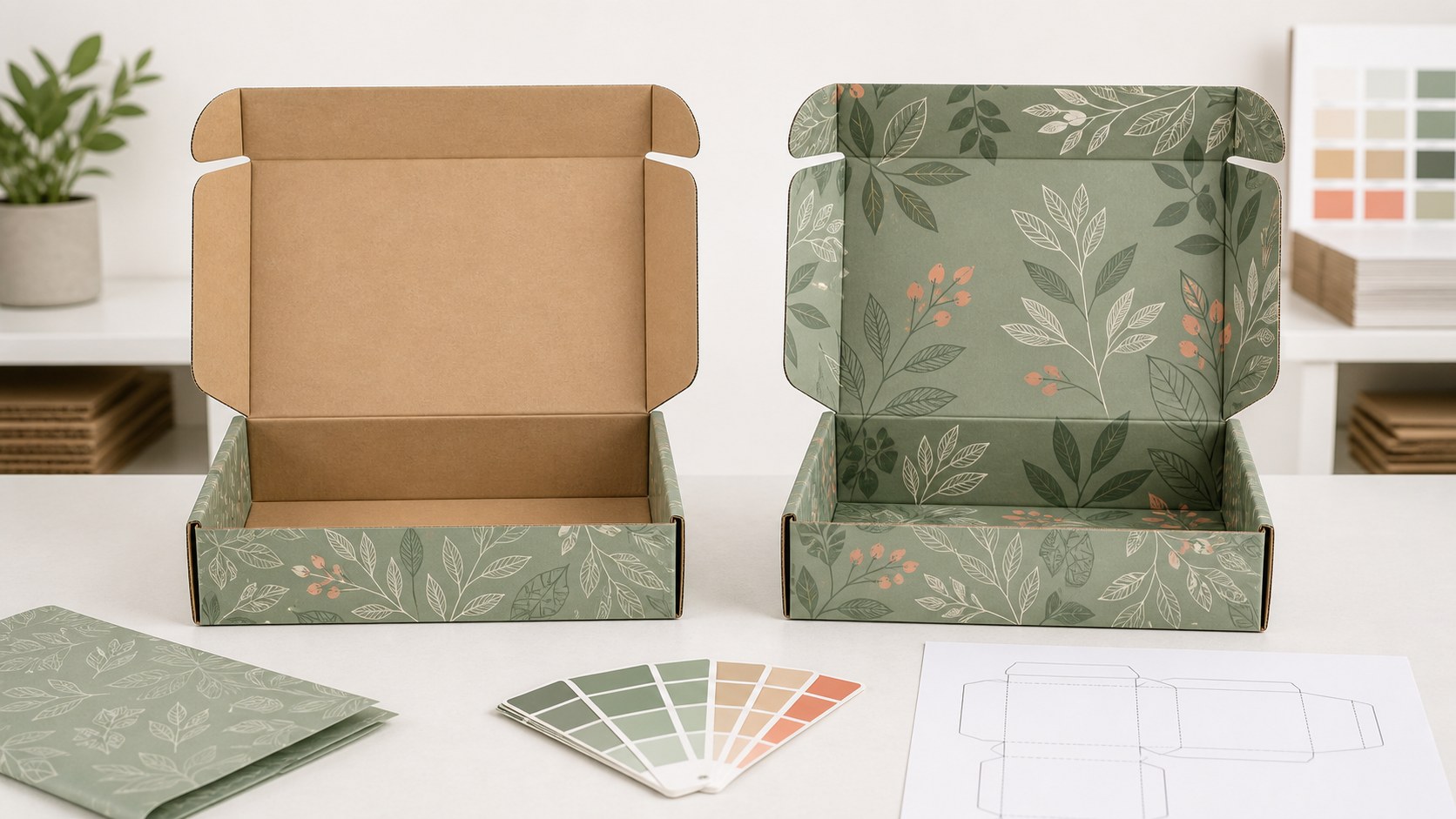
Branding is visible before opening and during delivery.
Branding continues across the lid, inner walls, and base during unboxing.
One main printed side, with the inside liner or reverse side left plain.
Artwork and production control are needed for both visible sides.
Usually the simpler starting point for a small custom order.
Can add printing, material, mounting, finishing, alignment, and loss costs depending on the box construction.
Launch orders, budget-sensitive packaging, and brands that use tissue, cards, or stickers inside.
Subscription boxes, PR kits, premium gifts, launch campaigns, and packaging designed for unboxing content.
One primary exterior artwork area.
Separate exterior and interior artwork areas, with fold direction and panel orientation checked together.
2. What extra costs can be added by a printed interior?
The exact quote depends on the construction and equipment. These are common cost drivers, not a universal fee list or guaranteed formula.
A second printed surface needs production preparation
Interior artwork still needs file checking, color planning, bleed, panel direction, and press preparation. A small printed message under the lid may use less ink than full coverage, but it may not remove the fixed setup needed for the interior printing process.
Some corrugated boxes need another printed liner
For a laminated corrugated mailer box, the exterior can use printed face paper mounted to corrugated board while the inner liner stays plain. A printed interior may require another printable liner, another print process, and additional mounting or bonding steps. The exact construction must be confirmed before quoting.
Finishing may be different on each side
The outside may need matte or gloss lamination for appearance and rub protection, while the inside may use no lamination or a different finish. If both sides need lamination or another coating, production steps and sample checks can increase again.
Alignment and fold direction become more sensitive
Interior graphics must land on the correct lid, wall, and base panels after mounting, die-cutting, creasing, and folding. Artwork orientation errors are more visible when copy or a pattern crosses several inside panels.
Setup loss and quality checks can increase
Color adjustment, mounting, registration, die-cutting, and inspection can create setup waste. Low-MOQ orders feel this more strongly because additional preparation and loss are divided across fewer finished boxes.
A realistic sample becomes more important
A digital sample can help review size and general appearance, but a machine sample is more useful when exact material, color, lamination, mounting, or inside-to-outside alignment must be checked before bulk production.
3. Box construction changes the inside-printing workflow
"Print both sides" is not enough information for an accurate quote. The supplier first needs to know what type of box and board will be used. Corrugated packaging itself combines outer and inner liners with a fluted medium, so the printing and mounting route can differ from a folding carton made from one paperboard sheet.
Outside-only printing commonly uses a printed face sheet mounted to corrugated board. A printed interior can require a second printed liner and more mounting, alignment, and loss control.
The board, ink system, equipment, color count, and whether the inside can run through the same equipment affect the workflow. Ask the supplier to confirm the number of print passes and any inside-print limitations.
The outside and reverse side can be printed on the same sheet at different stages, but reverse-side printing still adds press, drying, color, registration, and finishing considerations.
Inside printing may involve separate wrapped papers, lining papers, or inserts rather than simply printing the reverse of one sheet. MOQ and manual work can be higher, so it needs a separate construction review.
4. When is a printed interior worth the extra cost?
Inside printing is easier to justify when the open package is a major part of the product experience. Subscription boxes are opened in a repeated ritual. PR and influencer kits may appear in photos or video. Premium gifts and launch sets may need the inside lid to carry a story, campaign message, or coordinated visual reveal.
It may be less important when the box is mainly a protective shipping container, the customer removes the product immediately, the first order is testing demand, or the budget would create more value through better product protection, right-sized packaging, tissue, cards, or reliable delivery. A plain kraft interior can also be an intentional part of a natural material look rather than an unfinished choice.
5. Six ways to save cost without losing the unboxing experience
Use full exterior branding and retain a natural kraft or clean white interior when protection and delivery visibility matter more than a fully printed reveal.
A repeat-logo tissue sheet can create an interior brand layer while keeping the box construction simpler. It also works across more than one box size when planned carefully.
Put the thank-you message, care instructions, campaign story, or QR code on a separate card instead of printing a message across the inside lid.
A logo sticker can brand tissue, close a plain inner wrap, or add a seasonal message without creating another full box artwork version.
A one-color interior may reduce ink or plate complexity in some workflows, but it does not automatically remove interior setup. Ask for both options using the same box size and quantity.
One shared inside design can reduce artwork splits when several products use the same box structure. Keep product-specific information on cards or labels.
Ask suppliers to compare options using the same confirmed size, quantity, material, and destination. Otherwise a cheaper-looking print plan may be mixed with a different box construction or packing plan, making the comparison unreliable.
6. Artwork and sample checks for two-side printing
Prepare the exterior and interior on the supplier's confirmed dieline. Mark which side is the outside, which is the inside, and where the lid, base, side walls, locking tabs, glue areas, creases, and cut lines are located. Print-ready PDF or editable vector files are usually preferred for final production. Bleed and color settings should follow the supplier's prepress instructions rather than a generic online template.
Review artwork direction before sampling: a message can look upright on the flat dieline but become upside down when the lid opens. Also confirm whether the interior color is printed on kraft, white paper, or another liner because the paper color changes the result. Screen previews and digital samples are useful planning tools, but they do not guarantee an exact press color or final mounted appearance.
7. What to send for an outside-only vs two-side quote comparison
A complete request lets the supplier compare the printing plans without changing other assumptions. If the structure is not confirmed, send product dimensions, weight, photos, and the intended selling channel.
Printing quote checklist
- Box style and finished inside length x width x height
- Quantity per box size and per artwork version
- Corrugated or paperboard material preference
- Outside artwork and approximate ink coverage
- Inside artwork and which panels need printing
- CMYK, spot colors, or a request for a color recommendation
- Lamination or coating required on the outside and inside
- Digital sample or machine sample expectations
- Product type, destination, delivery route, and target timeline
Reviewed by Papyrn packaging team. Updated August 15, 2026. This guide explains common production and cost differences between outside-only printing and inside-and-outside printing for custom ecommerce boxes. It is not a fixed price formula. Final material construction, print method, MOQ, sample plan, color result, production time, and cost depend on confirmed box style, size, artwork, coverage, finish, quantity, destination, and current production arrangement.
FAQ
Inside and outside custom box printing questions
Is inside and outside box printing twice the price of outside-only printing?
Not necessarily. The increase depends on box construction, material, print method, color count, ink coverage, lamination, mounting, quantity, and setup loss. It can add a second print and liner workflow for some laminated corrugated boxes, but there is no universal multiplier.
Does printing only a small message inside the lid save much money?
It can reduce ink coverage, but the interior may still need separate artwork preparation, press setup, a printed liner, or another production pass. Ask for a comparison instead of assuming a small print area removes the fixed setup.
What is the cheapest way to brand the inside of a mailer box?
For many small brands, a plain interior combined with printed tissue paper, an insert card, a QR card, or a sticker is a practical starting point. The best option depends on quantity, box size, and how the package is opened.
When is inside printing worth the extra cost?
Inside printing is most useful when the open-box view is central to the customer experience, such as subscription boxes, PR kits, premium gifts, product launches, and packaging created for unboxing photos or video.
Do I need a machine sample for inside and outside printing?
A machine sample is recommended when exact color, material, lamination, mounting, or panel alignment is important. A digital sample can help with structure and general appearance but may not reproduce the final production process exactly.