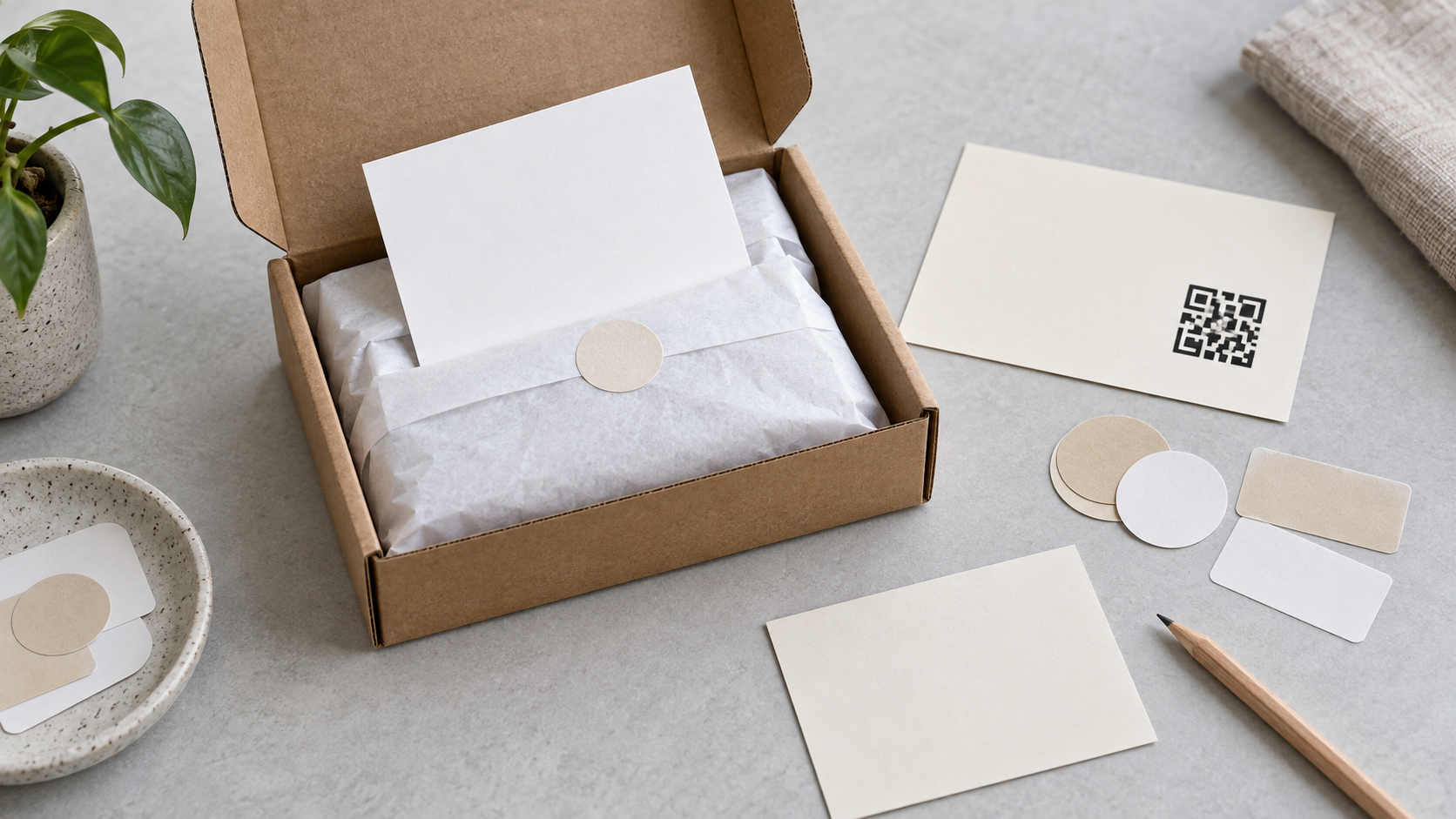
Short answer
Which packaging insert should a small brand choose?
Use a thank-you card when the next useful action is a short personal message. Use a QR or care card when the customer needs instructions, support, or an easy path to a relevant page. Use a sticker or seal for a branded closure or applied label. Start with one useful item; add another only when it has a different purpose. Test every QR code and adhesive on the actual printed material before ordering in bulk.
Papyrn packaging team experience
Small brands often ask for a thank-you card, a review card, a QR card, and several stickers at once. The more useful question is what should happen after the package opens. A buyer may need care instructions, a simple support route, or a clear way to reorder. A pile of inserts can obscure that message and add packing work.
Plan the card or sticker with the real box, tissue, product, and warehouse process. That makes its size, position, paper, adhesive, and copy easier to approve than judging a flat artwork file alone.
1. Thank-you card vs QR card vs sticker
A brief personal message, brand story, or useful next step. Best fit: A first order, gift, boutique product, or relationship-focused unboxing. Check: Do not crowd a small card with several competing requests.
Instructions, support, care information, reorder details, or one relevant landing page. Best fit: Products that need guidance after delivery or information that may change. Check: Keep essential safety or legally required information in an appropriate physical format; a QR link may not be enough.
A logo, closure detail, variant identifier, or campaign accent. Best fit: Plain boxes, tissue wrap, seasonal sets, or low-cost visual personalization. Check: Confirm adhesive, application surface, handling, and removal before bulk production.
Identification, variant, batch, or other product information. Best fit: Products needing an applied label rather than a loose insert. Check: Check the applicable market, carrier, and marketplace requirements separately.
A loose insert delivers a message; a sticker is applied to a surface. They should not be treated as interchangeable just because both can carry a logo. For formats and finish options, see custom insert cards and stickers.
2. Choose the message before the material
Give each insert one primary job. A thank-you card can acknowledge the order in the brand's voice. A care card should help the customer use or maintain the product. A QR card should make one destination easy to reach. A seal should close tissue or add a small visible identity cue. When the message is settled, choose the card size, writing space, surface finish, and placement.
For review requests, avoid promises, selective requests for only positive feedback, or incentives that conflict with the current marketplace or review-platform rules. A neutral invitation to share an honest experience is a better starting point, and the final wording should be checked against the channel where it will appear.
3. A budget-conscious packaging insert plan
One useful insert
Use one clear thank-you or care card when the customer needs a message or instructions. Avoid printing a second card just to repeat the first.
Insert plus closure
Pair a card with one sticker or seal when an unprinted box or plain tissue needs a visible brand cue.
One card with a QR destination
Use a card that combines a short message and one clearly labeled QR action when space and budget are limited.
Full coordinated set
Use separate care, campaign, and sticker elements only when each has a distinct job and the warehouse can pack them consistently.
The cost of a set is not just the print price. Separate designs, small quantities per version, special finishes, hand insertion, and sorting at the warehouse can change the landed cost. Ask for the complete packed-set plan instead of comparing only the unit price of each card.
4. Make the QR card genuinely usable
A QR card is useful only if it scans and leads to a page that helps the customer. Choose one clear destination such as care instructions or support. A short printed description should explain the action even before the buyer scans.
QR approval checklist
- Agree the final destination URL, page owner, language, and mobile experience before artwork approval.
- Use a destination that will remain available; plan who will maintain redirects if a campaign page changes.
- Print at final physical size on the intended paper and finish. Test with multiple common phones under realistic lighting.
- Check contrast, quiet space, trim safety, folds, coating, and whether the code becomes covered during packing.
- Label the action in words so the customer knows why to scan and can find an alternative route if scanning fails.
- If the destination collects personal data, check the applicable privacy notice and consent workflow.
The artwork guide covers file preparation, trim safety, print size, and proof approval. Do not use a QR-only route for information that must be present physically for the product or destination market.
5. Sticker, seal, and label are different jobs
A brand sticker may be placed on a box or included as a small gift. A seal must stay attached to tissue, a bag, or a carton through the intended handling. A product label may carry identifying or regulated information. The substrate, adhesive, printing, finish, and placement differ, so describe the exact job in the quote request.
Test the final sticker on the actual kraft, coated board, tissue, plastic, or other surface. A design that looks correct on its liner may lift, wrinkle, tear tissue, obscure important copy, or leave residue after application. Product-label and marketplace requirements need separate verification for the destination.
6. Approve the physical pack, not only the PDF
Review a physical sample when code scanning, color, legibility, writable areas, adhesive, or finish matters. Assemble the actual packaging set and check what the customer sees first, whether the card shifts or folds, and whether warehouse staff can apply each item consistently.
Sample and packing checks
- Finished size, orientation, and how the card sits inside the actual box or tissue wrap
- Readable copy, correct language version, spelling, URL, and approved artwork revision
- Paper and surface finish, especially where customers must write or scan
- Sticker shape, die line, adhesive, liner, peel behavior, and application surface
- QR scan at final size after printing, finishing, folding, and packing
- Packed quantity per order and how variants are separated for the warehouse
Use the sample approval guide to decide whether a digital or production-method sample is appropriate for a particular finish or print risk.
7. What to send for a useful quote
Buyer quote checklist
- Which items are needed: thank-you card, care/QR card, sticker, seal, or label
- Finished size, shape, quantity per design, and number of language or campaign versions
- Paper or sticker material, finish, adhesive or writable requirement, and a reference photo
- Print-ready artwork or logo, exact copy, QR target URL, and ownership of the destination page
- Where each item will be placed: on the box, tissue, product, or loose inside the parcel
- Destination and postal code, target date, and whether the items ship with boxes or other packaging
If the cards and stickers will ship with boxes, tissue, or filler, ask for a combined packing and freight plan. The shipping guide explains why product pricing and delivery terms should be compared separately.
Updated September 24, 2026. This is a planning guide, not a fixed MOQ, price, lead time, adhesive-performance guarantee, QR-scanning guarantee, marketplace approval, privacy, or product-compliance statement. Final specifications, copy, codes, materials, finish, packing, quantity, freight, and regulatory requirements must be confirmed for the actual product, destination, artwork, and current production arrangement.
FAQ
Cards and stickers questions from ecommerce buyers
Should I use a thank-you card, QR card, or sticker in my ecommerce package?
Start with the buyer's next need. Use a thank-you card for a brief message, a QR or care card for useful instructions or support, and a sticker or seal for a branded closure or label. Combine them only when each has a distinct job.
Can one card include both a thank-you message and a QR code?
Yes, if the card remains readable and the QR code has one clearly labeled destination. Check the code at final printed size on the actual paper and finish before approving bulk printing.
Can a QR code replace printed product instructions?
Not always. A QR link can supplement instructions, but access, connection, and the rules for the product and destination market matter. Keep essential safety or legally required information in the appropriate physical format when required.
What should a review request card say?
Keep it honest and neutral. A card can invite customers to share their genuine experience or contact support, but review incentives, filtering, and specific wording must follow the current rules of the marketplace or review platform used.
Do stickers work on kraft boxes and tissue paper?
They may, but performance depends on the substrate, coating, texture, adhesive, temperature, and application method. Test the actual sticker on the final box or tissue under realistic handling conditions.
Can Papyrn coordinate multiple language versions?
Papyrn can discuss separate artwork and packing plans for multiple language versions. Confirm quantity per version, exact copy, destination, and how the variants will be identified and packed.
What should I send for a card and sticker quote?
Send the item type, finished size, shape, quantity per design, material and finish, artwork, QR destination if any, language versions, application surface, delivery country, and whether the items ship with other packaging.